See which bacteria are growing in your baby’s gut.
In the first years, trillions of bacteria settle in your baby’s gut.
One stool sample shows which bacteria are there and how that community is developing.
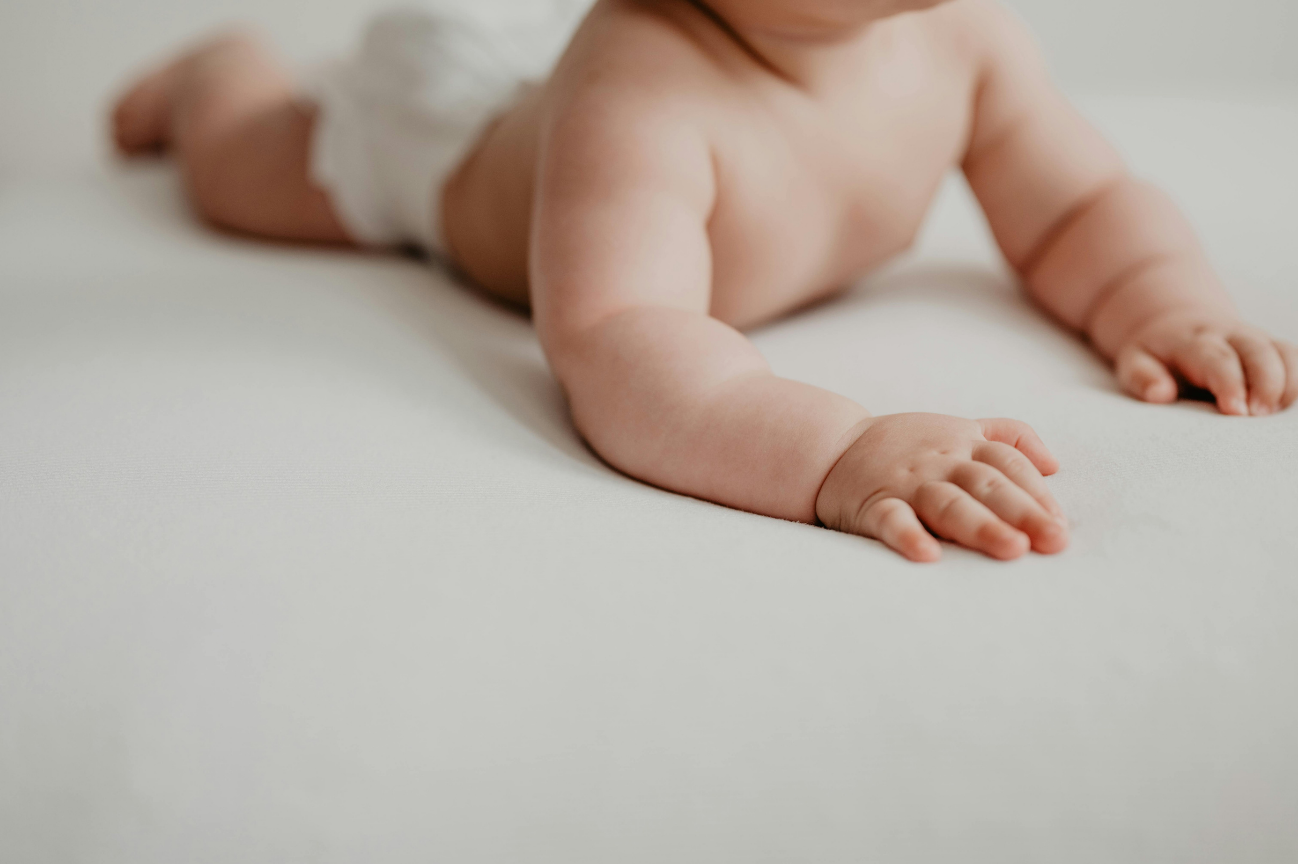
Why the early gut matters for your baby.
Your baby’s gut community forms over the first years of life. These bacteria do more than help with digestion: they support the gut barrier and help the immune system develop.
These early years are a window that doesn’t come again. How your baby was born, fed and cared for all shapes which bacteria take hold early on, and once the community is established it’s harder to change.
Scientists are studying how the early gut microbiome, including levels of Bifidobacterium, the milk-digesting bacteria, relates to the developing immune system and to conditions like eczema and allergies.
You can’t change how your baby was born or whether antibiotics were needed. But you can see what their gut community looks like now, instead of wondering: a starting point for understanding one of the most important systems developing in your child’s body.
The gut changes more in the first three years than it ever will again.
The bacterial community is not fixed. It arrives, shifts and settles over the first years, and where it ends up is largely where it stays.
The gut at three months looks nothing like it does at three years. Different bacteria, doing different things, in four rough chapters. So the same test tells a different story depending on when you take it.
Scroll sideways to see all four →
One test measures a single point on this curve.
Ages are approximate. These shifts follow feeding, not the calendar.
Low diversity early is not a deficit
A young infant's gut is meant to be a small, specialised community. Diversity climbs as the diet widens.
The dip is supposed to happen
Bifidobacterium leads while milk is the main food, and its share falls back once solids arrive.
Then the fibre eaters arrive
Bacteria like Faecalibacterium, Blautia and Roseburia ferment fibre into short-chain fatty acids that nourish the gut lining.
A test is a snapshot of a moving picture.
The birth story doesn’t tell you what’s inside.
A caesarean birth, antibiotics, formula, arriving early, time in the NICU: each of these shapes the early gut. But shaping is not deciding. Two babies with the same start can look quite different, and a textbook start is no guarantee.
A baby born vaginally and breastfed can still have very little Bifidobacterium.
That is the whole reason to measure rather than assume. Most samples look reassuringly typical, whatever the start; where something stands out, we say so plainly.
So what does a test actually tell you?
Three things on every report, and a fourth if you test again. Below is a short peek inside.
The bacteria present
Which bacteria are there and in what proportion, from the leading groups down through the long tail.
So what?You find out what’s actually in there, instead of guessing.
How it’s developing
From this one sample: which chapter your baby is in, which groups lead at their age, and what’s expected to shift next.
So what?A number that’s perfectly normal at four months reads very differently at two years. This is the context.
Key early markers
Above all Bifidobacterium, which should be one of the most common bacteria in the first months.
So what?A few things worth knowing, not forty numbers to decode.
If you test again
Your baby’s own samples side by side, months apart, so you can see which way things are heading.
So what?One test is a snapshot. Two is a direction.
I wanted this test for my own daughter. It didn’t exist here.
My daughter went straight to the NICU after she was born, with a lung infection, and spent her first week on antibiotics. I had spent years studying the gut during my PhD in Biotechnology at Cambridge, so I knew what a week of antibiotics does to a microbiome, especially one that’s barely started. I went looking for a test to show me what was happening in hers. It existed in Europe and the US, but not here, and almost all of it was built on infants nothing like ours. So I started ilali.
The research behind it →What this test is, and what it isn’t.
ilali offers a wellness test, not a diagnostic one. It describes the bacteria in your baby’s gut and how the community is developing. It does not diagnose illness, detect pathogens, or predict disease. For anything medical, speak to your paediatrician.
From kit to report, in a few simple steps.
Order your kit
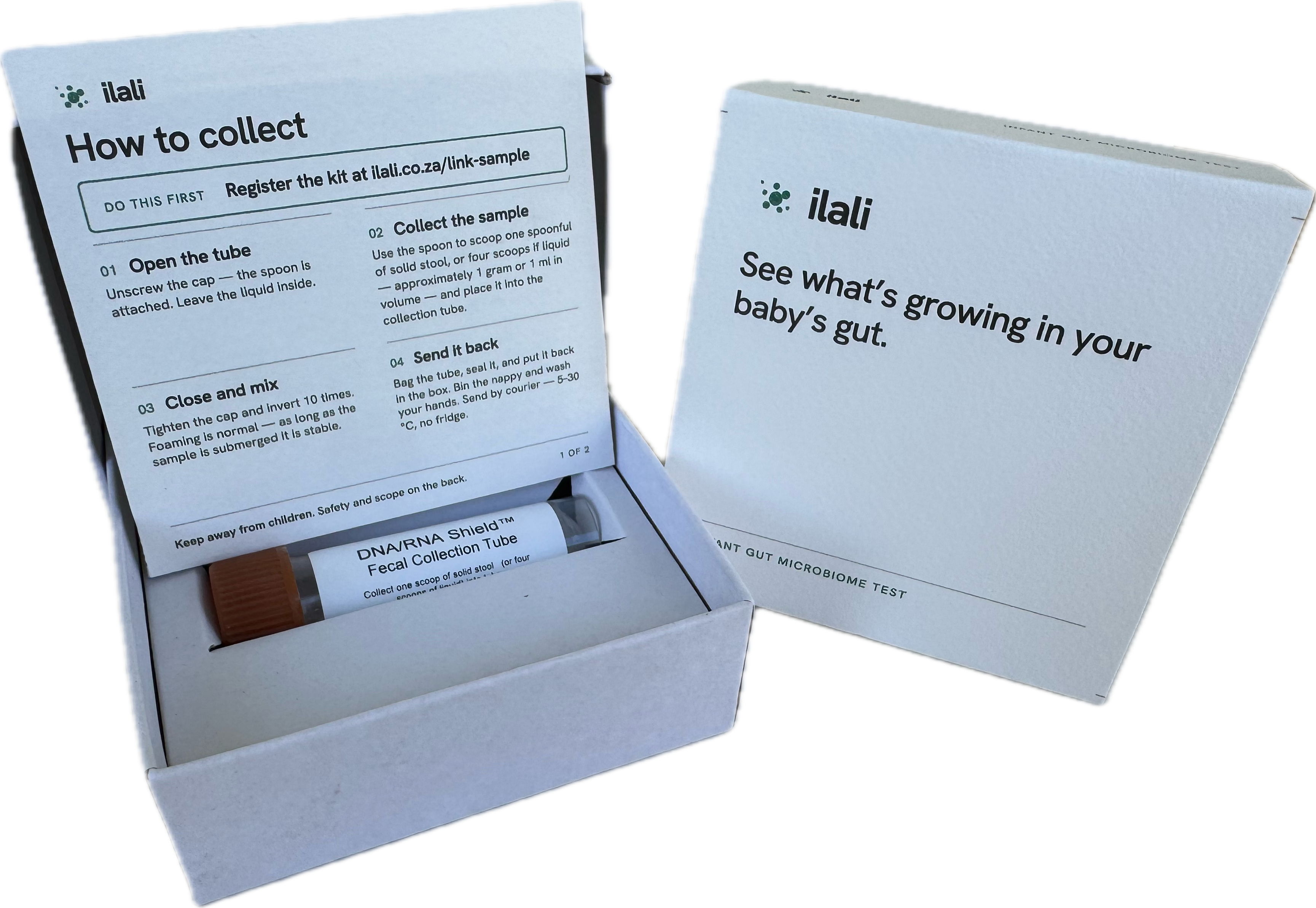
A single tube arrives at your door, pre-filled with preservative, with a small spoon built into the lid. Nothing to refrigerate.
Collect the sample
A pea-sized stool sample at a nappy change, or from the potty. Close the tube, shake, and the preservative keeps it stable at room temperature.
Register your kit
Enter the ID from your tube on our site, along with a few quick details. We can’t process a sample without this. It’s what links the tube to your baby in our database.
Send it back and read your report
We automatically send a courier to collect your sample, or you can choose to ship it yourself. A few weeks later we send you the report via email.
Straight answers.
Is this a medical test?
No. It’s a real lab measurement, but not a diagnostic. It describes what’s present in your baby’s gut, and it isn’t a substitute for medical advice. For anything about your child’s health, your paediatrician is the right person.
When should I test?
Any time in the first three years, and the earlier the more informative. Many families test once around two to three months and again after solids are established.
What if the result worries me?
The report is written to be read calmly. Most of what you’ll see is the normal variation of early life. If something genuinely stands out, we explain plainly what it means, and what it doesn’t.
Who is this for?
ilali is designed for babies and children from about one week to three years old, the window when the gut microbiome is developing fastest. Below one week it’s too early to read the community reliably; by around three it’s settled into a more adult-like pattern.
What’s in the kit?
One collection tube (preservative already inside, spoon built into the lid), a how-to-collect sheet, and the packaging to send it back. Nothing needs refrigerating at any point.
What if the sample can’t be read?
Occasionally a sample doesn’t yield enough DNA to report on honestly. If that happens we tell you, and send a replacement kit at no charge. We’d rather re-collect than report a result we don’t trust.
Can I test again later?
Yes, and it’s the most useful thing you can do. A second test shows how the community is changing rather than where it stood once. Repeat kits are discounted for families who’ve tested before.
What does it cost?
The first 50 kits are free for South African families. Ongoing pricing will be published here before general sale.
What happens to your child’s data.
We know your child’s health data matters to you, so these are the principles behind how we treat it.
Your report is yours
It belongs to you and your child, not to us. You can ask us for it, or ask us to delete it.
POPIA from the first sample
Consent and data handling were built to South Africa’s data protection law before we sequenced anything, not retrofitted later.
Never shared
We’ll never share any personal details about you or your child with any third party.